Design the review screen first. Put the supplier’s evidence on the left. On the right, show the purchases whose emissions estimate would change if an analyst accepted it. The difficult part is deciding exactly which purchases the evidence describes.
This matters because “supplier-specific” sounds like a quality guarantee. A foundry might send a carefully measured annual footprint for a site that produces both lightweight brackets and machined housings. Allocate that total by revenue and a price increase can change the emissions assigned to a housing even when production stays the same. The GHG Protocol explicitly cautions that supplier-specific methods can be less accurate than secondary data. A reviewer needs to see the allocation decision before accepting the number. GHG Protocol guidance on purchased goods and services, chapter 1
Build around three records
An activity records a delivery of castings, a shipment leg or a month of electricity consumption. Give it a stable identity and link it to the evidence. A purchase order, invoice and goods receipt can describe the same delivery. Importing all three should improve the record while leaving the quantity unchanged.
An estimate records how you accounted for that activity. Store its quantity, unit, reporting entity, period, emissions component, method and factor version. Under an operational-control boundary, fuel burned in the company’s furnace falls in Scope 1, generation of its purchased electricity in Scope 2, and production of metal it buys in Scope 3. The scope belongs to the reporting company’s relationship with the activity. You can’t infer it from the word “aluminium”. GHG Protocol Corporate Standard
A revision records a proposed change, the evidence for it, its reviewer and the estimates it supersedes. Original files can live in object storage. A relational database can hold the activities, estimates and revisions. Give the agent read access to evidence and tools to prepare revisions. Give the analyst the authority to approve a new allocation method. Let a deterministic calculation service apply approved rules, including on routine imports. That division also gives you an audit trail you can replay after the model changes.
The Scope 3 supplier workflow
Screen the GHG Protocol’s 15 categories before building a supplier worklist. Procurement records help estimate purchased goods. Freight needs shipment legs and the party that bought the service. Use of sold electric equipment needs units sold in the reporting year and assumptions about lifetime energy use. Assign each relevant category an owner and a source you can reconcile against. A complete purchase ledger can still miss the biggest source of emissions in the business. GHG Protocol Scope 3 calculation guidance
For purchased goods, start outreach where an answer could change a decision. Rank suppliers using estimated emissions, uncertainty and what the buyer can influence. A large, well-understood purchase may warrant less attention than a smaller casting order where the production route is unknown and a sourcing decision is due. Let the agent prepare the shortlist. The buyer knows when the contract renews and who at the foundry actually knows how the part is made.
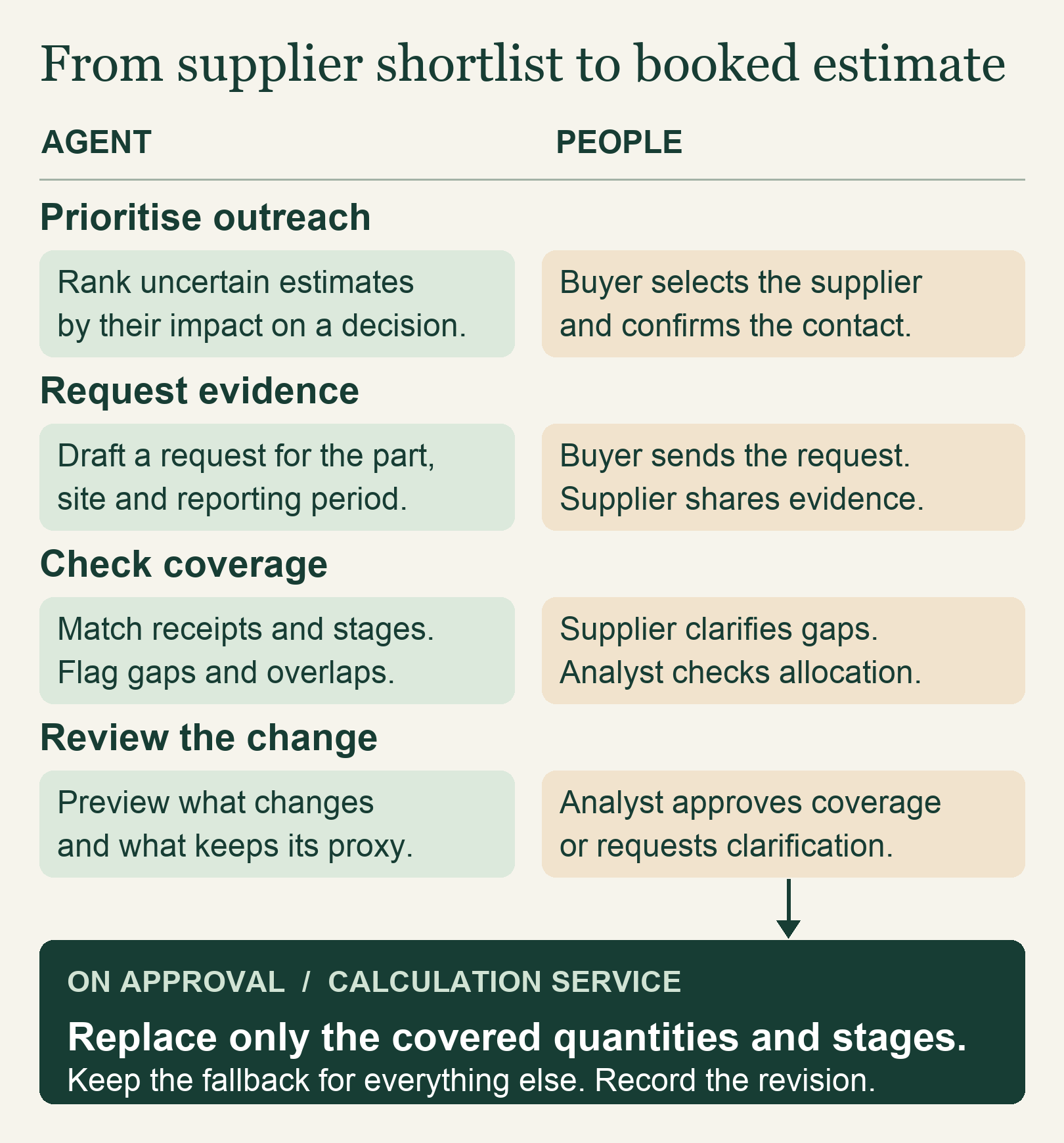
Asking for a finished footprint assumes the supplier has calculated one. Persefoni designed its supplier programme around that gap. Its Pro workspace gives suppliers tools and training, and its Data Exchange supports requests for emissions and allocation details. Build that flexibility into the request. A foundry with a product declaration can share it. One with furnace logs and production records can share enough to develop an allocation. A company total alone leaves the buyer’s existing estimate in place until someone can justify the share attributable to its purchases. Persefoni supplier engagement · Data Exchange release
What makes a supplier response usable?
First, match the claim to the purchase. Check the part, producing site, unit, period and processes covered. A cradle-to-gate declaration for a rough casting from the east plant can cover metal production and casting for matching receipts. Keep freight after the foundry gate, machining at the buyer’s plant and the proxy for west-plant purchases. If the buyer only knows which distributor shipped the part, the agent can ask the distributor which plant made this batch.
Then check what the supplier measured. The PACT exchange format can carry a footprint’s boundary, primary-data share, verification information and identifiers for earlier versions. These answer different questions. Primary-data share describes how much of the footprint comes from primary inputs. Verification can cover the supplier’s calculation model or the individual product. Ask what was verified and whether the allocation fits this order. A reviewer can accept the measured furnace energy, retain secondary estimates for upstream metal, and document how the two fit together without overlapping. PACT methodology · PACT exchange fields
Finally, preview the replacement. Key coverage to the receipt, quantity and process stage. Show what would be retired, what would remain and why. Commit the approved revision and its replacements together. Replaying the same submission should have no effect. A corrected declaration should produce a new draft for affected receipts, while the signed report remains reproducible. Measure progress by the share of comparable purchases now covered by accepted evidence. Response rate measures the success of the email campaign.
Where AI earns its keep
A fixed import can read an ERP export. An agent becomes useful when the next step depends on what it finds. For an invoice marked “express delivery”, have it retrieve the shipment, inspect the dispatch note for the transport mode, then attach the supporting line to a proposed match. If the note is silent, draft a question for logistics. Beetroot makes this distinction between coordinating an investigation and running an approved calculation. Persefoni’s Data Agent lets reviewers change suggested field mappings and export the decision log. Its Copilot supports accounting questions, while anomaly detection identifies records worth checking against the source. Beetroot on agentic carbon accounting · Persefoni Data Agent · PersefoniAI
Give the agent a factor catalogue it can query. The GHG Protocol sets accounting boundaries. EPA eGRID supplies US electricity data, the UK government publishes conversion factors for activities including freight, and ecoinvent models industrial processes under specified life-cycle assumptions. Climatiq brings sources like these behind a common interface, including tools agents can call over MCP. Filter by unit, geography, year and process boundary before ranking candidates. Save the chosen factor ID and release. A life-cycle electricity factor can be an excellent match for the words on a bill and still double count upstream emissions when used alongside a separate Scope 3 energy estimate. EPA eGRID · UK conversion factors · ecoinvent system models · Climatiq tools
Product footprint assessment adds a bill of materials, a production route and allocation of shared energy to outputs. SAP documents how it traces metered energy and cooling through a production resource to products. Climatiq’s preview PCF Screen can go the other direction, inferring a provisional product model from a name and manufacturing location. Use that model to choose what to investigate. If changing the assumed metal source reverses which bid looks better, the buyer has learned exactly which fact to request before awarding the contract. SAP product footprint walkthrough · Climatiq PCF Screen
Explain why the footprint moved
A supplier can improve its evidence and make your reported emissions go up. Before calling a change a reduction, run the same receipts through the old and new methods. That comparison isolates the effect of changing the estimate for those purchases. To assess operational progress, compare periods on a consistent basis and check changes in volume and product mix. For a material methodology change, apply the company’s documented base-year recalculation policy. Keep the originally reported and restated figures available. GHG Protocol Scope 3 Standard, chapter 9
Test the platform on an awkward close. Replay a declaration, correct its plant, and remove the evidence for its freight boundary. The replay should add nothing. The correction should affect only matched purchases. The missing boundary should reach a reviewer. Count unsupported replacements that slipped through as well as review time saved. An agent can clear a queue remarkably quickly by accepting everything in it.
What changes in India
Model electricity by source. An Indian manufacturer may combine distribution-company supply, open-access purchases and on-site generation. Keep meter readings, fuel records and contractual evidence separate. India’s Central Electricity Authority publishes grid averages as well as operating and build margins used to assess projects. A project’s estimate of displaced generation answers a different question from the average emissions attributable to a plant’s grid consumption. Encode that distinction in the catalogue. Weather data such as ERA5 can help investigate a change in cooling demand, while the electricity inventory still uses the metered consumption. CEA database guide · GHG Protocol Scope 2 Guidance · Copernicus ERA5
Design the supplier workspace so the same plant can answer different buyers. A listed customer preparing a Business Responsibility and Sustainability Report may request value-chain data. An EU importer of covered steel goods may need installation and production information under CBAM. Reuse the fuel log, production period and site identity. Apply the boundary required for each output. The practical test is whether the supplier can correct one furnace record and see which buyers’ figures need another look. SEBI’s BRSR Core FAQ · European Commission CBAM guidance